
Of Solenoids and Spherical Electromagnets

Working on modelling the magnetic field that will be used to quench a 4 inch lead superconducting sphere in the h-ray experiment.  The first trial was just to place the superconductor in a surrounding solenoid electromagnet.  The correct magnitude of field can be obtained that way, but the uniformity isn't great.  Adding more layers of windings increases the field strength but doesn't help with the uniformity.  Each level of coils basically linearly increases the field strength.  The percent change in field with length along the solenoid, (shown on the x axis below), stays pretty much the same though.  The graphs shown are for one, two, and three layers of coils.


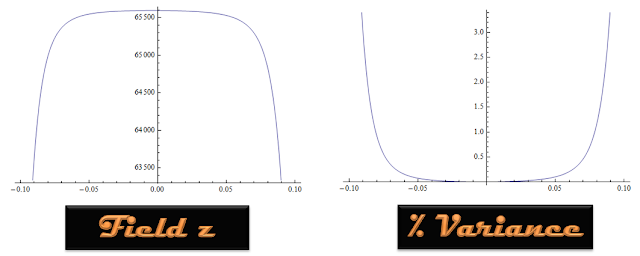
While looking around for a coil design that would give a more uniform field I came across a patent[1] that described a spherically wound electromagnet and promised a uniform field within the sphere.  I tried modified the model to handle a spherically wound coil and got the results along the up-down axis, (z), and the equatorial axis, (r), of the coil shown in the graphs below.  The z direction has a very nice improvement.  The radial direction, even with it's 17% or so variance between the field at the center and the edge of the coil is still far better than the plain-old solenoid designs.


Comments

  1. Have you looked at this type of spherical electromagnet for your experiment.

    This is the picture of it:
    http://www.justodians.org/SphericalMagnet/01ElecMagPic1.htm

    This is the patent application which is now in the public domain and free for all to use:
    http://www.justodians.org/SphericalMagnet/PatentApp.htm

    I invented it years ago but never had the opportunity to experiment with it.

    Good Luck
    John

    ReplyDelete

Post a Comment

Please leave your comments on this topic:

Popular posts from this blog

Cool Math Tricks: Deriving the Divergence, (Del or Nabla) into New (Cylindrical) Coordinate Systems

Now available as a Kindle ebook for 99 cents ! Get a spiffy ebook, and fund more physics The following is a pretty lengthy procedure, but converting the divergence, (nabla, del) operator between coordinate systems comes up pretty often. While there are tables for converting between common coordinate systems , there seem to be fewer explanations of the procedure for deriving the conversion, so here goes! What do we actually want? To convert the Cartesian nabla to the nabla for another coordinate system, say… cylindrical coordinates. What we’ll need: 1. The Cartesian Nabla: 2. A set of equations relating the Cartesian coordinates to cylindrical coordinates: 3. A set of equations relating the Cartesian basis vectors to the basis vectors of the new coordinate system: How to do it: Use the chain rule for differentiation to convert the derivatives with respect to the Cartesian variables to derivatives with respect to the cylindrical variables. The chain ...

The Alcubierre Warp Drive Tophat Function and Open Science with Sage

I transferred yesterday's Mathematica file with the Alcubierre warp drive[2] line element and space curvature calculations to the  +Sage Mathematical Software System  today, (the files been  added to the public repository [3]).  If you haven't used Sage before, it's a Python based software package that's similar in functionality to Mathematica.  Oh, and it' free.  I also worked a little more on understanding the theory, but frankly, I made far more progress with the software than the theory.  What follows will be a little more of the Alcubierre theory, plus, a cool Sage interactive demo of one of the Alcubierre functions[1], as well as a bit about my first experience with using Sage. Theory The theory is fun, but it's moving slowly.  Here's the chalk board from this morning's discussion Alcubierre setup the derivation using something called the 3+1 formalism which means we consider space to be flat, (in this case), slices that are labelled ...

The Valentine's Day Magnetic Monopole

There's an assymetry to the form of the two Maxwell's equations shown in picture 1.  While the divergence of the electric field is proportional to the electric charge density at a given point, the divergence of the magnetic field is equal to zero.  This is typically explained in the following way.  While we know that electrons, the fundamental electric charge carriers exist, evidence seems to indicate that magnetic monopoles, the particles that would carry magnetic 'charge', either don't exist, or, the energies required to create them are so high that they are exceedingly rare.  That doesn't stop us from looking for them though! Keeping with the theme of Fairbank[1] and his academic progeny over the semester break, today's post is about the discovery of a magnetic monopole candidate event by one of the Fairbank's graduate students, Blas Cabrera[2].  Cabrera was utilizing a loop type of magnetic monopole detector.  Its operation is in...