
Fun with Grey Lines

 It's so much fun when the propagation physics works out in amateur radio. The last few days, the little Rockmite 20 meter radio de KD0FNR has caught the grey line to canada, and the immediately been seen nowhere again until the sun completely up about two hours later. Here's what the gang and I have seen while watching the Reverse Beacon Network while calling CQ.


On Mondy, the Rockmite was heard as the grey line crossed the spotting station in Canada


I should point out again, that no, we're not in Nebraska, we just freuqently get aliased from KD0FNR to KD0F. 

Then, today we hit the grey line on both sides, first as it passed by us:


And then one last time as it passed by the spotting station about 10 minutes later:


And then, just as the day before, nothing for a few more hours:
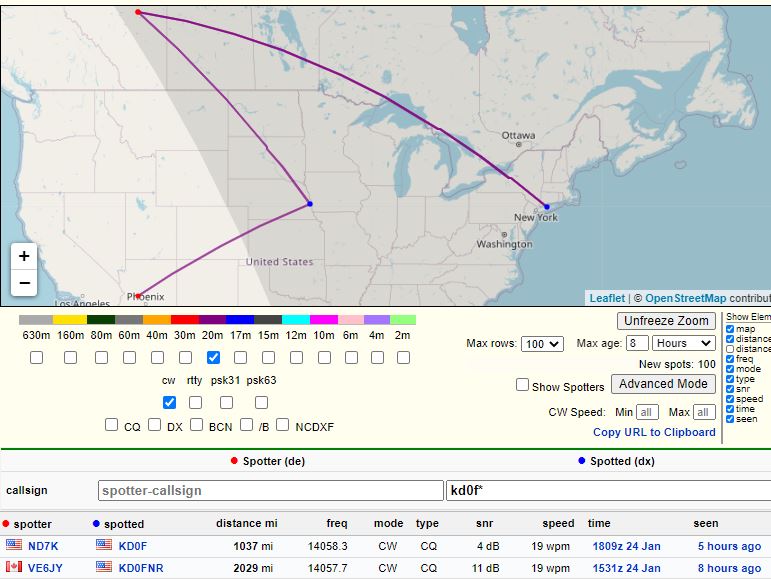
The above picture was taken just now when I'm writing this up now, so please ignore the picture's grey line, but do look at the time stamps between the last Canada spot, VE6JY and the first Arizona spot, K07K. (Also, we used to be in New York years ago, but now we're in San Francisco.)


Comments

Popular posts from this blog

Cool Math Tricks: Deriving the Divergence, (Del or Nabla) into New (Cylindrical) Coordinate Systems

Now available as a Kindle ebook for 99 cents ! Get a spiffy ebook, and fund more physics The following is a pretty lengthy procedure, but converting the divergence, (nabla, del) operator between coordinate systems comes up pretty often. While there are tables for converting between common coordinate systems , there seem to be fewer explanations of the procedure for deriving the conversion, so here goes! What do we actually want? To convert the Cartesian nabla to the nabla for another coordinate system, say… cylindrical coordinates. What we’ll need: 1. The Cartesian Nabla: 2. A set of equations relating the Cartesian coordinates to cylindrical coordinates: 3. A set of equations relating the Cartesian basis vectors to the basis vectors of the new coordinate system: How to do it: Use the chain rule for differentiation to convert the derivatives with respect to the Cartesian variables to derivatives with respect to the cylindrical variables. The chain ...

The Alcubierre Warp Drive Tophat Function and Open Science with Sage

I transferred yesterday's Mathematica file with the Alcubierre warp drive[2] line element and space curvature calculations to the  +Sage Mathematical Software System  today, (the files been  added to the public repository [3]).  If you haven't used Sage before, it's a Python based software package that's similar in functionality to Mathematica.  Oh, and it' free.  I also worked a little more on understanding the theory, but frankly, I made far more progress with the software than the theory.  What follows will be a little more of the Alcubierre theory, plus, a cool Sage interactive demo of one of the Alcubierre functions[1], as well as a bit about my first experience with using Sage. Theory The theory is fun, but it's moving slowly.  Here's the chalk board from this morning's discussion Alcubierre setup the derivation using something called the 3+1 formalism which means we consider space to be flat, (in this case), slices that are labelled ...

The Valentine's Day Magnetic Monopole

There's an assymetry to the form of the two Maxwell's equations shown in picture 1.  While the divergence of the electric field is proportional to the electric charge density at a given point, the divergence of the magnetic field is equal to zero.  This is typically explained in the following way.  While we know that electrons, the fundamental electric charge carriers exist, evidence seems to indicate that magnetic monopoles, the particles that would carry magnetic 'charge', either don't exist, or, the energies required to create them are so high that they are exceedingly rare.  That doesn't stop us from looking for them though! Keeping with the theme of Fairbank[1] and his academic progeny over the semester break, today's post is about the discovery of a magnetic monopole candidate event by one of the Fairbank's graduate students, Blas Cabrera[2].  Cabrera was utilizing a loop type of magnetic monopole detector.  Its operation is in...