While searching for journal articles on the Schwinger-Lippmann scattering rule last night, I came across the following.
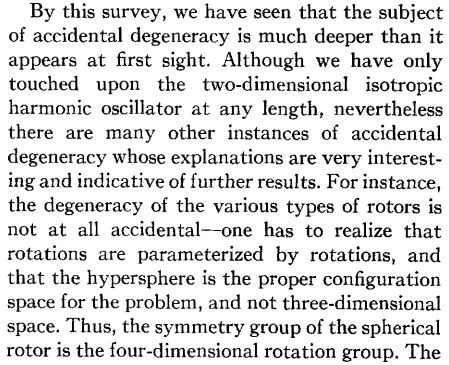
Maybe We Let Quaternions Go A Little Too Easily
http://aapt.scitation.org/doi/abs/10.1119/1.1934944
 Relation of quaternions to four dimensional rotations[2]
If you're into fringe physics, McIntosh worked for RIAS who dabbled in shall we say 'gravity control' in the 1950s.
RIAS Inc. of Baltimore[3]
RIAS on antigrav[4]
McIntosh did a significant amount of group theory work and went on to publish a survey of flexagons in 2003[pdf][5]. This brings us to the really cool flexagon stuff! First, watch the series of videos on hexaflexagons[10]!
Then, go read more about them at the American Mathematical Monthly[6] and Scientific American[7]. They were invented in 1939 and while Feynman didn't come up with the idea, he was involved.

Epstein again
The author that pointed out Israel Senitzky also wrote a paper on quantum mechanical scattering[8]. Interestingly, he's not associated with an institution and we find him in New York, NY. Reading up on him, it looks like he was at Columbia at the time. He wound up at the University of Wisconsin[9].
References
1. On Accidental Degeneracy in Classical and Quantum Mechanics
http://ajp.aapt.org/resource/1/ajpias/v27/i9/p620_s1
2. http://en.wikipedia.org/wiki/Rotations_in_4-dimensional_Euclidean_space#Relation_to_quaternions
3. http://en.wikipedia.org/wiki/Research_Institute_for_Advanced_Studies
4. http://en.wikipedia.org/wiki/United_States_gravity_control_propulsion_research#Research_Institute_for_Advanced_Study_.28RIAS.29
5. http://delta.cs.cinvestav.mx/~mcintosh/cellularautomata/FLEXAGONS_files/gonaflex.pdf
6. The American Mathematical Monthly, 64, (1957), "Flexagons"
http://www.jstor.org/stable/10.2307/2310544
7. Scientific American, December, 1956, "Flexagons"
http://www.nature.com/scientificamerican/journal/v195/n6/index.html
8. http://prola.aps.org/abstract/PR/v86/i6/p836_1
9. http://www.physics.wisc.edu/alumni/pdf/newsletter-spring2011.pdf
10. http://www.youtube.com/watch?v=VIVIegSt81k
Maybe We Let Quaternions Go A Little Too Easily
http://aapt.scitation.org/doi/abs/10.1119/1.1934944
If you're into fringe physics, McIntosh worked for RIAS who dabbled in shall we say 'gravity control' in the 1950s.
RIAS Inc. of Baltimore[3]
RIAS on antigrav[4]
McIntosh did a significant amount of group theory work and went on to publish a survey of flexagons in 2003[pdf][5]. This brings us to the really cool flexagon stuff! First, watch the series of videos on hexaflexagons[10]!
Then, go read more about them at the American Mathematical Monthly[6] and Scientific American[7]. They were invented in 1939 and while Feynman didn't come up with the idea, he was involved.
from +Scientific American
Epstein again
The author that pointed out Israel Senitzky also wrote a paper on quantum mechanical scattering[8]. Interestingly, he's not associated with an institution and we find him in New York, NY. Reading up on him, it looks like he was at Columbia at the time. He wound up at the University of Wisconsin[9].
References
1. On Accidental Degeneracy in Classical and Quantum Mechanics
http://ajp.aapt.org/resource/1/ajpias/v27/i9/p620_s1
2. http://en.wikipedia.org/wiki/Rotations_in_4-dimensional_Euclidean_space#Relation_to_quaternions
3. http://en.wikipedia.org/wiki/Research_Institute_for_Advanced_Studies
4. http://en.wikipedia.org/wiki/United_States_gravity_control_propulsion_research#Research_Institute_for_Advanced_Study_.28RIAS.29
5. http://delta.cs.cinvestav.mx/~mcintosh/cellularautomata/FLEXAGONS_files/gonaflex.pdf
6. The American Mathematical Monthly, 64, (1957), "Flexagons"
http://www.jstor.org/stable/10.2307/2310544
7. Scientific American, December, 1956, "Flexagons"
http://www.nature.com/scientificamerican/journal/v195/n6/index.html
8. http://prola.aps.org/abstract/PR/v86/i6/p836_1
9. http://www.physics.wisc.edu/alumni/pdf/newsletter-spring2011.pdf
10. http://www.youtube.com/watch?v=VIVIegSt81k
Comments
Post a Comment
Please leave your comments on this topic: