
Electron Diffraction and Reciprocal/Fourier Sapces

After several lectures in other classes where the use of electron diffraction was described in terms of reciprocal spaces, (the Fourier transform of position as opposed to position itself), I finally saw a great explanation of why we work in the reciprocal space to learn about the structure of crystals and other materials in plain position space.  The diagram shown below, (picture 1 on Google+), sums it all up.

Put very simply, there's a very clean relationship for how an electron is diffracted based on the electron's momentum wave which is the Fourier reciprocal of the probability vs. position wave in quantum mechanics.  However, to write this relationship down in its cleanest form, you first have to describe the diffracting media in the reciprocal space as well.  Hence, the emphasis on the reciprocal space even though results are often finally translated back to position space for human consumption.

The atoms that form the cell structure in crystals are distributed periodically.  There positions can be written using basis vectors determined by the type of the crystal cell and the position of the next cell over can be inferred by the periodicity.  It's this structure that lends itself to being Fourier transformed.

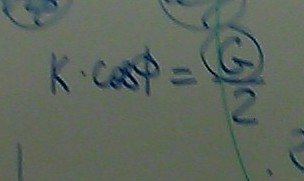
The electron wave function is diffracted by this grid of atoms that forms the cell structure, (scattering points).  The magnitude of the momentum of each electron can't be changed, only the direction of the momentum, and then only by the magnitude of the reciprocal space vector, (labeled G), that joins one scattering point to the next, (see the diagram above).  The angle between the momentum and the G vector is denoted by phi and the angular distance between spots on a diffraction pattern can be calculated using, (picture 2).


Here's a question.  Does the angle between momentum and G have to be transformed back into position space to correspond to the observed diffraction pattern?  I'm guessing not since the change in direction of the momentum variable directly corresponds to where that portion of the electron beam 'landed'.  In this case, we're actually looking at the deflection of the momentum vector on the screen.  Another great reason that lectures about electron diffraction seem to always start in momentum space!


Picture of the Day:
From 1/19/13

Comments

Popular posts from this blog

Cool Math Tricks: Deriving the Divergence, (Del or Nabla) into New (Cylindrical) Coordinate Systems

Now available as a Kindle ebook for 99 cents ! Get a spiffy ebook, and fund more physics The following is a pretty lengthy procedure, but converting the divergence, (nabla, del) operator between coordinate systems comes up pretty often. While there are tables for converting between common coordinate systems , there seem to be fewer explanations of the procedure for deriving the conversion, so here goes! What do we actually want? To convert the Cartesian nabla to the nabla for another coordinate system, say… cylindrical coordinates. What we’ll need: 1. The Cartesian Nabla: 2. A set of equations relating the Cartesian coordinates to cylindrical coordinates: 3. A set of equations relating the Cartesian basis vectors to the basis vectors of the new coordinate system: How to do it: Use the chain rule for differentiation to convert the derivatives with respect to the Cartesian variables to derivatives with respect to the cylindrical variables. The chain ...

The Alcubierre Warp Drive Tophat Function and Open Science with Sage

I transferred yesterday's Mathematica file with the Alcubierre warp drive[2] line element and space curvature calculations to the  +Sage Mathematical Software System  today, (the files been  added to the public repository [3]).  If you haven't used Sage before, it's a Python based software package that's similar in functionality to Mathematica.  Oh, and it' free.  I also worked a little more on understanding the theory, but frankly, I made far more progress with the software than the theory.  What follows will be a little more of the Alcubierre theory, plus, a cool Sage interactive demo of one of the Alcubierre functions[1], as well as a bit about my first experience with using Sage. Theory The theory is fun, but it's moving slowly.  Here's the chalk board from this morning's discussion Alcubierre setup the derivation using something called the 3+1 formalism which means we consider space to be flat, (in this case), slices that are labelled ...

How Many Files Can You Add to a GPT Project? An Interview with GPT-5 on Limits, Context Engineering Tips, and Chats

 Setting the scene: I’m tinkering with Project TouCans, knee-deep in radio logs, SQLite dumps, and Cesium code. Naturally, I’m wondering if shoving all this into one GPT Project is a recipe for brilliance… or for disaster. So I turn to Vril — you know, after Brainy from the Legion of Super-Heroes , because what else do you call your AI sidekick who always has the answers? Time to ask him straight up. [ As an aside, yes, GPT-5 has decided to sometimes call me Vail. I'm not sure why to be honest. Also, I asked Vril, er GPT-5, to write up our interview for me. Apparently, me asking it to 'Bro' up a few stories, just for fun, has convinced Vril that I use 'Like,' more than I actually might. ] Me (Vail): So Vril, how many files can I throw into a GPT Project before it just starts choking? Like, is there some magic number where the context window taps out and everything falls apart? GPT-5 (Vril): Great question. There’s no single hard file limit. What matters is ...